Points are getting pointless


Credit card rewards were always paid for by a fee you never saw. That fee is about to be cut by more than half — and the way most of us actually pay never rewarded us at all.
By the Pyng team·July 2026·5 min read
There's a quiet reckoning coming for the little dopamine hit you get when your credit card statement says you've earned 4,000 points. Not because points are going away overnight, but because the machine that funds them is being switched to a lower setting — permanently — from 1 October 2026. And once you understand how that machine works, you'll see why “earn rewards on every purchase” is heading toward the fine-print equivalent of a participation trophy.
Let's pull it apart.
The engine you never see
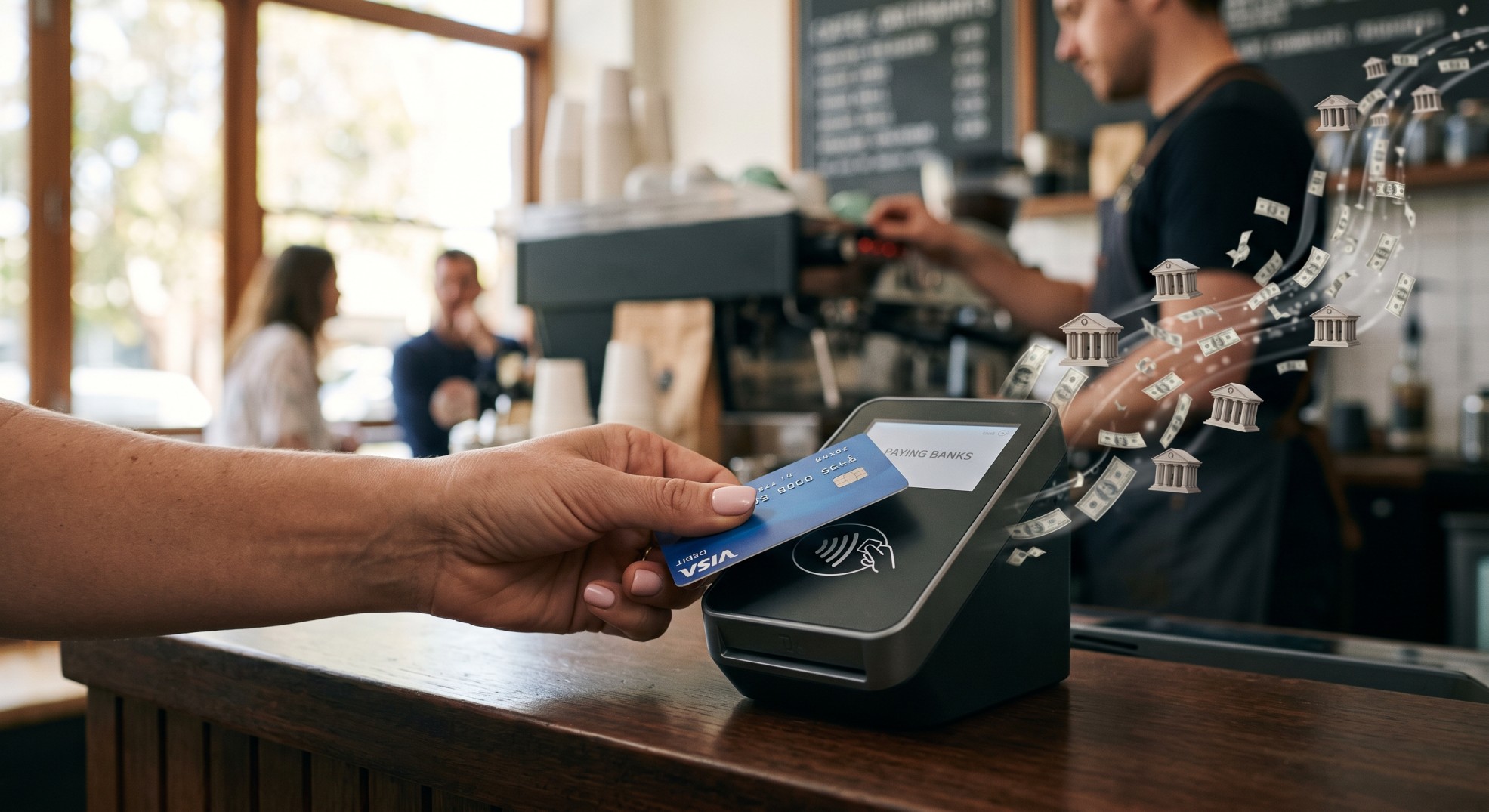
Every time you pay with a card, a small wholesale fee called interchange moves quietly in the background — paid by the merchant's bank to your bank, the one that issued your card. You never see it. The merchant does: it's baked into the fees they pay to accept cards.
Here's the part that matters: that interchange fee is the fuel for your rewards. When your bank collects a slice of every dollar you spend, some of it gets recycled into points, sign-up bonuses, lounge passes and cashback to keep you swiping. Rewards were never a gift from your bank's generosity. They were a marketing budget funded by a fee on merchants — and, ultimately, on the prices we all pay.
Turn down the fuel, and the fire gets smaller. Which is exactly what's about to happen.
What actually changes on 1 October
As part of its 2026 payments overhaul, the Reserve Bank is doing two things at once. It's banning card surcharges (the bit everyone's talking about) — and it's cutting interchange (the bit that quietly matters more for your points).
For personal credit cards, the interchange cap drops from 0.8% to 0.3%. The old weighted-average benchmark that gave banks room to move disappears too. The RBA estimates the whole package takes roughly $910 million a year out of what merchants pay — and it's been refreshingly blunt about where a chunk of that money was going: subsidising card issuers' loyalty programs.
You don't have to take our word for what happens next. During the RBA's consultation, the banks themselves said that if interchange was cut, they'd respond by reducing rewards, trimming earn rates, and lifting card fees. That's not a warning from cynics on the internet. That's the issuers telling the regulator their plan.
We've seen this movie before
If it feels speculative, it isn't — because it's already happened here, and overseas.
The last time Australian interchange was reduced, in July 2017, many banks cut their points earn rates almost the moment the change took effect. Same cause, same effect. Expect the 2026 version to rhyme: lower points per dollar, tighter bonus caps, and quietly fatter annual fees on the premium cards.
For a preview of the destination, look at Europe. Interchange there sits at around 0.3% — precisely where Australia is headed — and the result is a credit card market with almost no meaningful rewards to speak of. The UK, at similar levels, offers a fraction of the sign-up bonuses and earn rates Australians have been used to. When the fuel runs at European levels, you get European rewards. Which is to say: not much.
So the trajectory for credit card points is clear. Not a cliff, but a slow, deliberate deflation — worth a little less each year, hedged with more conditions, until “earn rewards” means rounding error.
Debit cards: the reward that never was
Here's the twist most of the coverage skips.
Most Australians — and almost everyone under 35 — don't live on rewards credit cards at all. They tap a debit card or a phone. And debit has never rewarded you for a single transaction, because the economics were never there. Debit interchange is tiny (it's dropping again in October, from 0.2% to 0.16%), so there's simply nothing to recycle into points. Tap to pay for your coffee, your groceries, your bus fare — thousands of times a year — and you get precisely nothing back. Not a point. Not a cent.
And the sting in the tail: because interchange has been a cross-subsidy, everyday debit users have effectively been helping fund the rewards of premium credit cardholders. You paid into a rewards system you were never invited to.
So play it forward. Credit card points are deflating toward not-much. Debit — how the next generation actually pays — was always zero. The mobile wallet you tap rides the very same rails underneath, so it inherits the same nothing. Strip it all back and you're left with a strange conclusion for 2026: the simple act of paying, for most people, most of the time, rewards you not at all — and the one place it did is fading.
So what should paying actually do?
Step back and the whole thing looks a little absurd. We've built a payments culture where the reward you get depends on holding the right premium product, funded by a hidden fee on everyone, administered as points you'll half-forget to redeem — and even that is being wound down. Everyone pays in. Fewer and fewer get anything out.
Here's the question worth sitting with: why should the reward depend on holding the right $700-a-year card, or on a rewards budget that's quietly evaporating? Why shouldn't the everyday act of paying — however you do it — simply do something for you, transparently, every single time?
For most Australians, most of the time, paying rewards you not at all — and the one place it did is fading. That's not a small gap. It's a hole right in the middle of how the whole country pays.
We've got some thoughts on how to fill it. More on that soon.
General information only, current as at July 2026, and not financial advice — interchange and rewards settings are set by the RBA and individual issuers and may change. Sources: RBA, Review of Merchant Card Payment Costs and Surcharging — Conclusions Paper (March 2026) and 2026 media release; RBA Payments System Board interchange determinations.