The Humble QR Code Is Changing How the World Gets Paid — And Australian Small Businesses Are Finally Catching On


You've seen them everywhere. On café tables, at market stalls, on the back of business cards. That little square of black and white pixels has quietly become one of the most powerful tools in
modern commerce — and for small businesses in Australia, it could be the smartest payment decision you make in 2026.
Here's why the rest of the world already figured this out — and why it's your turn.
The World Has Already Made the Switch
QR code payments aren't new. In much of Asia, they`ve been the dominant way people pay for years — and the numbers are staggering.
India's UPI system, built on QR technology, now processes over 19 billion transactions a month — that's more than 7,000 transactions every single second, outpacing global card networks. Over nine million merchants across India accept QR payments, from street food vendors to department stores.
China processes more than 90% of all mobile payments via QR code. Walk into almost any shop, market stall or restaurant in Beijing or Shanghai and you'll find a QR code waiting to be scanned — no card terminal, no EFTPOS machine, no fees disappearing into the banking system.
In the Philippines, a small sari-sari store owner or food vendor in Cebu can accept digital payments without investing in card terminals at all, simply by displaying a QR code. It's become a tool for financial inclusion as much as convenience.
And it's not just developing economies. In the United States, QR code payments are shifting from niche to mainstream, with merchants increasingly drawn to them as a way to avoid expensive interchange fees. The global QR code payment market was valued at over $12 billion in 2024 and is projected to reach nearly $62 billion by 2033.
The world has voted. QR codes are how payments are heading.
So Why Haven't More Australian Small Businesses Made the Move?
It's a fair question. Australians are comfortable tappers — we've been world leaders in contactless card payments for years. But tapping a card comes at a cost that most small business owners feel every single month: interchange fees, scheme fees, terminal rental, and payment provider margins that quietly eat into every sale.
QR payments can function similarly to bank transfers — confirmed immediately, with zero interchange fees when settled directly. They provide the cost benefits of cash without the handling risks.
That's a fundamentally different proposition to the card payment model most Australian businesses have accepted as the cost of doing business. It doesn't have to be.
What Actually Happens When a Customer Scans Your QR Code
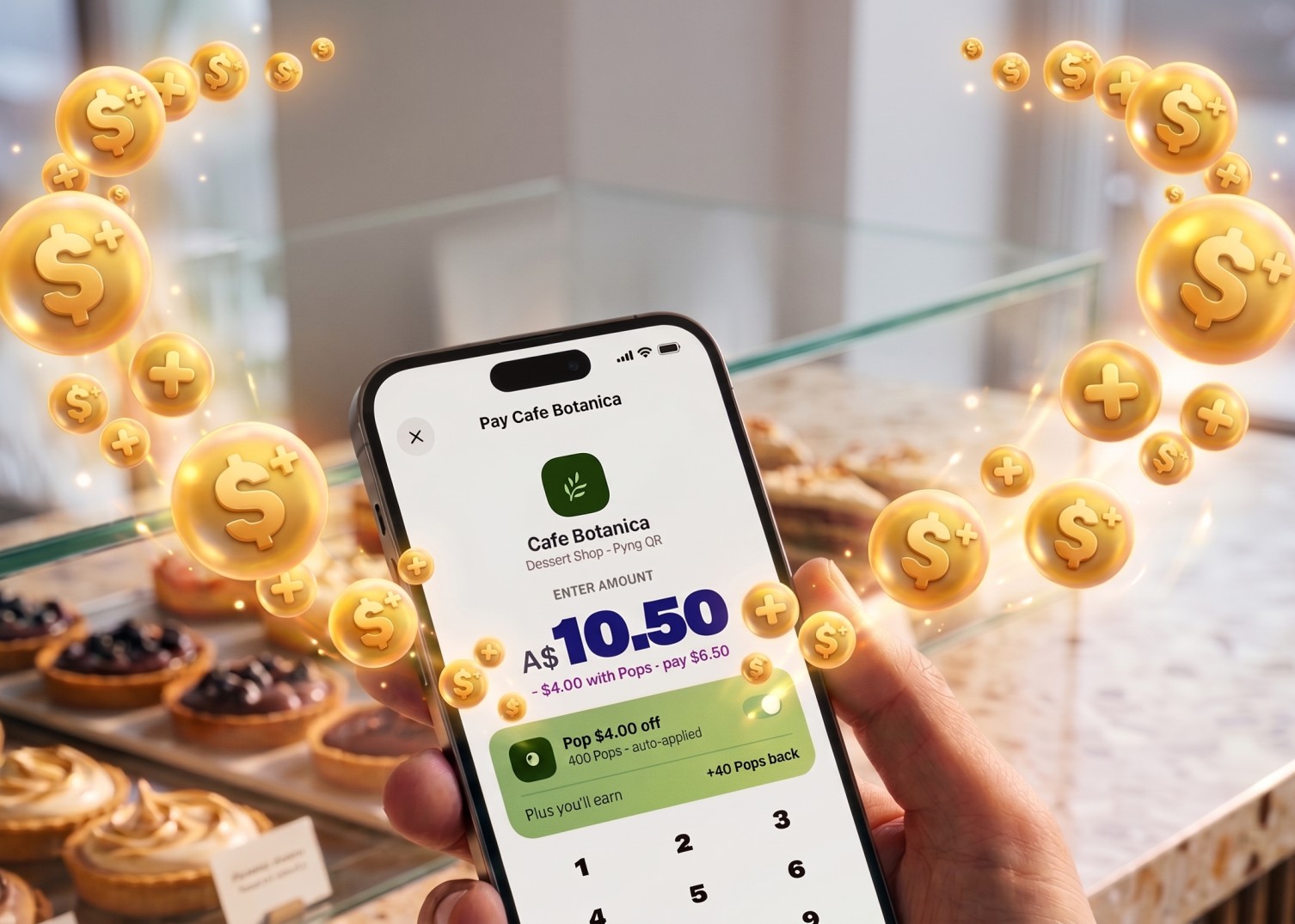
With Pyng, it couldn't be simpler. You display a static QR code — printed, laminated, stuck to your counter, taped to your window, wherever works for you. Your customer opens their phone camera, scans it, and pays. Done. No card reader. No terminal. No monthly rental. No percentage clipped off every transaction.
The payment lands in your account and Pyng absorbs the cost. For you, it's completely free.
There's nothing to set up, nothing to maintain, and nothing to go wrong with a hardware device — because there is no hardware device. Just a code on your counter and a payments infrastructure doing the heavy lifting behind the scenes.
"But Is It Safe?"
This is the question we hear most often — and it's a fair one. Here's the honest answer: yes, and here's why.
QR code payments use encryption and tokenisation to protect customer information. Even if a QR code is intercepted, the customer's payment information remains secure.
Direct bank transfers through QR codes use strong customer authentication, reducing the risk of fraud, while cards are more susceptible to cloning and chargebacks.
And this is where Pyng goes further than most.
One known vulnerability with static QR codes is physical tampering — a bad actor placing a fraudulent sticker over a legitimate code to redirect payments. It's rare, but it happens. Pyng addresses this head-on with dynamic QR codes generated directly through the Pyng app.
Unlike a static code that always points to the same destination, a dynamic QR code is generated fresh for each transaction — unique, time-limited, and tied directly to a specific payment. There's nothing to tamper with because the code itself changes every time. Customers scanning a Pyng dynamic QR code via the app can be confident they'e paying exactly who they intend to pay, with no opportunity for interception or redirection.
Think of it as the difference between a fixed sign on your door and a one-time password — both get the job done, but one is inherently more secure.
So with Pyng you get the best of both worlds:
- A static QR code for everyday display — on your counter, your window, your table — for quick and easy customer payments
- A dynamic QR code via the Pyng app when you want maximum security on a per-transaction basis
The Business Case Is Simple
Let's put it plainly. Every time a customer pays you by card today, you lose a percentage of that sale to fees. On a $50 transaction with a 1.5% effective rate, that's 75 cents. Across hundreds of
transactions a day, that adds up to thousands of dollars a year — money that stays with your payment provider rather than in your pocket.
With Pyng's QR code solution, that number is zero. Not lower. Zero.
Small businesses that have moved to QR code payments have seen up to a 20% increase in revenue from transaction fee savings alone. When you're not giving away a slice of every sale, it changes the economics of your business.
And with surcharging being banned from October 2026, the timing has never been better to rethink your payment setup entirely.
Two Ways to Accept Payments with Pyng
Static QR code — always on, always ready Print it, laminate it, stick it anywhere. Your customers scan and pay in seconds. Perfect for countertops, market stalls, pop-up shops, tradie invoices, and anywhere you want a set-and-forget payment solution.
Dynamic QR code via the Pyng app — maximum security per transaction Open the Pyng app, generate a unique code for the exact transaction amount, and your customer scans it. The code is tied to that specific payment and expires immediately after use. Ideal for higher-value transactions, mobile businesses, or any situation where you want complete confidence that every payment is going exactly where it should.
Both options cost you nothing.
Getting Started Takes Minutes
One of the most common misconceptions about QR payments is that they're complicated to set up. They're not — especially with Pyng.
There's no hardware to order, no technician to book, no integration to build. Download the Pyng app, get your QR code, and you're ready to accept payments. That's it.
The barrier to entry is almost zero — a café in Newtown or a boutique in Fitzroy can compete with national chains by offering the same convenience and speed through QR payments, using tools that cost nothing to get started.
Your customers already know how to scan a QR code. They do it every day — for menus, for check-ins, for loyalty programs. Paying with one is the same muscle memory, just pointed at
your business.
The Bottom Line
The rest of the world worked out years ago that QR codes are a faster, cheaper, and more secure way to get paid. Australia is catching up — and the combination of the surcharge ban, lower interchange fees, and growing consumer comfort with scanning means the timing is perfect.
For small businesses, the appeal is clear: no hardware, no monthly fees, no percentage of every sale lost to the payment system. A static code on your counter for everyday payments. A dynamic code in your app when security matters most. And zero cost either way.
That's Pyng.
Ready to get your free Pyng QR code? [Download the app and set up in minutes.]